Bill Gates Warns AI Risks Outpace Nuclear Weapons
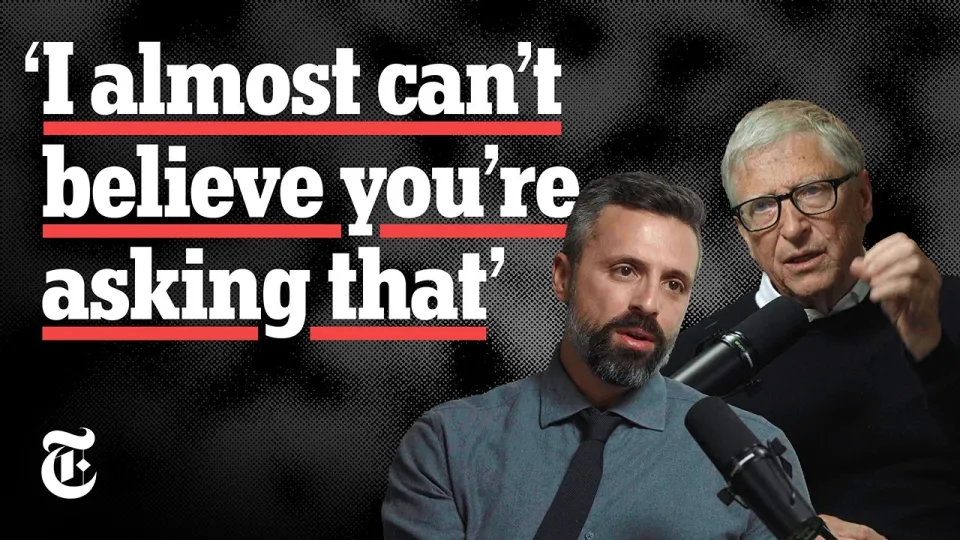
Video: Bill Gates: A.I. ‘Makes Nuclear Weapons Look Like Nothing’ | The Ezra Klein Show
Need articles like this for your video? They help promote it on YouTube and Google — order them in the Telegram bot @sat_sit_bot. The bot writes and publishes the articles itself (with your YouTube video embedded) on popular topical websites (no ads). Your first 50 articles are free.
· based on the channel The Ezra Klein Show
Key takeaways
- Gates argues AI is the most dangerous technology humanity has approached, comparing its stakes to — and beyond — nuclear weapons.
- He identifies two near-term danger thresholds: AI-enabled cyberattacks and bio-terrorism, both of which could cause mass casualties.
- Gates calls the idea that the AI industry can self-regulate 'insane' and compares relying on lawsuits to a fantasy.
- He points to mass job loss as a third disruption and discusses taxing AI labor and 'human reserved' roles.
- The Gates Foundation, set to spend down roughly $200 billion over two decades, has made AI-driven inequality a new priority.
Bill Gates argues that artificial intelligence is the most dangerous technology humanity has ever approached, warning that it could enable catastrophic cyberattacks, bio-terrorism and mass job loss — and that the idea the AI industry can regulate itself is "insane." He made the case in a wide-ranging conversation with Ezra Klein, published on The Ezra Klein Show, whose full transcript is available at the New York Times opinion page. The core of his message: AI alarmism has not gone far enough, and the people in positions of authority are in denial about what is coming.
What Bill Gates actually fears about AI
Gates frames AI as a risk multiplier rather than a single discrete threat. His argument is that the same general-purpose capability that can design drugs or write code can also be pointed at pathogens or critical infrastructure, and that the speed of improvement leaves institutions far behind. In the conversation he describes AI as more consequential than nuclear weapons, a comparison that sets the tone for the entire episode.
Three specific concerns recur:
- Cyber risk. AI lowers the cost and raises the sophistication of attacks on software, power grids and financial systems, making large-scale disruption feasible for small groups.
- Bio risk. Gates treats the ability to design or enhance dangerous biological agents as a threshold that must be crossed carefully, because a single release could kill on a scale no lawsuit can remedy.
- Labor disruption. Beyond security, he expects rapid displacement across white-collar work, with consequences for wages, tax revenue and social stability.
Why self-regulation fails, according to Gates
The most quoted moment of the interview is Gates rejecting the idea that AI companies will police themselves. He treats voluntary commitments as structurally unreliable: firms compete on capability and speed, and the incentives that drive them point away from caution. When Klein raises the possibility of holding companies accountable through litigation after harm occurs, Gates pushes back sharply — the scale of a catastrophic event makes after-the-fact legal remedies meaningless.
His preferred framing is that regulation must be set before deployment, not after damage. That means government-defined thresholds for dangerous capabilities, mandatory reporting when a model crosses them, and licensing or audit requirements for the labs building frontier systems. Gates does not claim regulators currently have the expertise to do this well; he argues that the gap is a reason to build that capacity now rather than to wait.
The race with China and the safety trade-off
Gates acknowledges the tension at the heart of AI policy: slowing down for safety risks ceding advantage to competitors, particularly China. He does not resolve this tension so much as insist it be managed deliberately. The comparison to nuclear arms control is implicit — dangerous technologies have historically been governed through treaties, inspections and shared thresholds rather than unilateral restraint.
The practical implication is that safety rules need international buy-in to be durable. A single country imposing strict limits while others accelerate simply relocates the risk. Gates' position is that the United States and its allies should move first on capability thresholds and then push for matching commitments abroad, rather than treating regulation and competitiveness as opposites.
Jobs, taxes and a no-scarcity labor market
On employment, Gates is more optimistic than on security but still expects significant pain. He describes a future in which AI absorbs tasks across law, accounting, customer service and software development, and where the transition is uneven — some workers gain leverage, many lose it.
His proposals in the conversation include:
- Taxing AI labor. If machines perform work that previously generated payroll taxes, the revenue base for social programs erodes, so new forms of taxation on automated production become a policy question rather than a slogan.
- "Human reserved" jobs. Certain roles — care work, teaching, some public services — may be deliberately reserved for people, both for quality and for social reasons.
- A no-scarcity job market. Gates sketches a scenario in which productivity gains lower the cost of goods and services enough that new categories of work emerge, though he does not claim the adjustment will be smooth or fast.
He also stresses that the benefits and harms will not be distributed evenly across countries. Developing nations may get faster access to medical and agricultural tools, but they also have the least capacity to absorb labor shocks and the weakest regulatory institutions.
Inequality as the Gates Foundation's new priority
Gates recently announced that making AI a force for equality — rather than an accelerant of inequality — is a new priority for the Gates Foundation, which is set to spend down roughly $200 billion over the next two decades. That framing matters because it shifts the foundation's role from pure philanthropy toward shaping how the technology is deployed in health, education and agriculture.
On education, Gates is cautiously positive: AI tutoring can be personalized and cheap in ways human tutoring never was. But he also flags learning loss in rich countries as a warning that technology alone does not fix schooling, and he supports specific regulatory protections for children's use of AI products.
Common questions viewers raised
The conversation provoked unusually strong reactions, and several recurring doubts are worth addressing directly. One is whether Gates' alarm is genuine or performative; the intensity of his disagreement with his host, and his willingness to push back on questions rather than deflect them, is what many listeners noticed most. Another is the fairness of comparing AI to nuclear weapons — Gates uses the comparison to convey scale of consequence, not to claim the risks are identical in mechanism.
A third theme is Jensen Huang's view that market incentives will produce remedies for harmful products. Gates rejects that logic outright, pointing to a century of disasters that capitalism did not prevent on its own. A fourth is the gap between wealthy and poor countries: as one line in the episode puts it, inequity persists partly because of distance, and AI could widen it if access and governance are uneven.
Useful links
- Full transcript of the Bill Gates interview on The Ezra Klein Show
- Book recommendations from guests of The Ezra Klein Show
Bottom line
Gates' argument is not that AI should be stopped but that it is being deployed faster than the institutions meant to govern it can adapt. His three pressure points — cyber, bio and jobs — each require policy before harm rather than litigation after it, and he is explicit that industry self-regulation is not a substitute for government action. The Gates Foundation's planned spend-down of about $200 billion gives him a platform to push AI toward equality rather than inequality, but he is clear that philanthropy cannot replace regulation. The full discussion, including his comments on foreign aid and education, is available through The Ezra Klein Show, which produced this interview and the transcript linked above.
Source: Bill Gates: A.I. ‘Makes Nuclear Weapons Look Like Nothing’ | The Ezra Klein Show · Markdown version
Questions & answers
Why does Bill Gates compare AI to nuclear weapons?
Gates uses the comparison to convey the scale of consequence rather than an identical mechanism of harm. His point is that a single AI-enabled cyber or bio event could cause casualties on a level no legal or market remedy could address, which puts the technology in a category beyond ordinary product risk.
Does Gates believe AI companies can regulate themselves?
No. He calls the idea "insane" and argues that competitive pressure pushes labs toward speed over caution. Voluntary commitments cannot substitute for government-set capability thresholds, reporting requirements and audits applied before deployment rather than after damage.
What does Gates propose for jobs displaced by AI?
He discusses taxing AI labor to protect the revenue base for social programs, designating some "human reserved" roles in care and teaching, and a longer-term scenario where productivity gains lower costs enough for new job categories to emerge. He does not claim the transition will be smooth.
How is the Gates Foundation involved in AI?
The foundation, set to spend down roughly $200 billion over two decades, has made steering AI toward equality a new priority. That includes deployment in health, education and agriculture, plus attention to how labor shocks hit developing nations with weaker institutions.